Fire at the Undertakers !
Do you ever wake up in the morning having had a dream that has taken you back to when you were much younger, stirring up memories perhaps long forgotten? This is what recently happened to an ex-Newbold Verdon resident, Tonia Sorrell, prompting her to get in touch with the Archive.
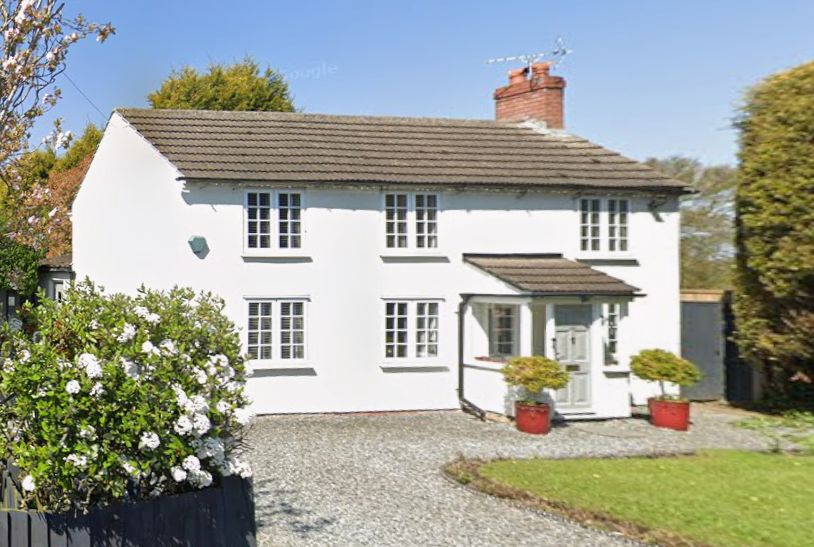
In the 1970s, Tonia lived with her mum, dad and sister at 193 Main Street – today’s white house on the corner of the junction of Main Street and Desford Road. Her dream had awakened two distinct memories: the first of her dad’s shed, the second of fire at the house. Tonia wanted to know if we could confirm a story her dad once told her.
Now, we are used to getting requests for information on people’s relatives or the places where they once lived, but we have never had this in the form of a beautifully crafted story which we would like to share with you.
Here is Tonia’s Story
It may have been 1975 when the holly hedge burned down. We’d been out all day, a long, hot dusty countryside summer day – maybe to an event, maybe Abbey Park show? Maybe even shopping in town, I really don’t remember, and there’s no-one left to ask, but it was summer and it was, it turns out, a tinderbox of a day.
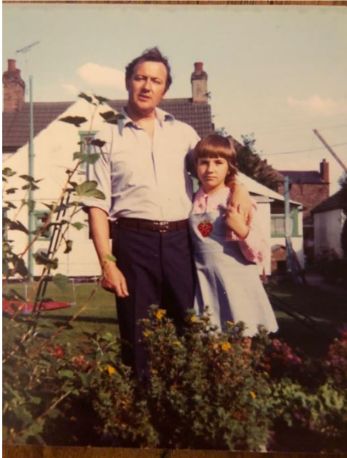
As I recall, the holly-hedge was ten feet tall, at least 3 feet deep, and ran along the road, enclosing one side of the long, private back garden of our cottage. The cottage was a dream home for Mum, with actual, functional beams, a kitchen that seems huge in memory, with a hidden click-click door in its panelled wall, behind which a short snail of spiral stairs led to the bedrooms.
A long-sloped roof to the side of the kitchen, low enough to jump off into a forward roll on the bouncy turf, covered the outbuildings, a spacious light open area, probably at one time for animals, but in our tenure, shelter for the bikes, garden tools and Mum’s impressive leather-shoe-sewing machine. And Dad’s fascinating shed.
An old, low wooden door opened into the gloomy enclosed space. Stepping down I can feel the soft earth floor, smell wood-shavings and the rusty, oily tang of old tools festooning whitewashed lumpy walls. Where the tools came from, I never thought to ask. This was their second house, the first, brand new would not have justified all this kit, planes, carving tools, saws with flaking painted handles red, blue and green. I can see shallow crates stacked to one side of the chunky, deeply scarred wooden worktop, backlit by the old metal-framed quartered window, opened just a crack.
“Years ago, this used to be the village undertaker’s place, don’t tell your Mum,”, dad told me, one weekend afternoon, as we were dipping my corgi cars into a psychedelic 70’s oil-float painting kit. And I didn’t. But I remember wondering how it worked, where the bodies lay, for how long, were there ghosts, and if so, why couldn’t I see them? And now, long past opportunities to ask him, I wonder why he told me, and was it really a secret.
For years the old, dense, deep-evergreen hedge held us safe, muffled the noise and fume of traffic, sheltered us from by-passers eyes, as we galloped round the garden, or played in paddling pools in endless pre-puberty summer days. But, unseen at its base among the thick, twining stems, decades of oily, dry leaf-litter had dropped, spiky kindling, laying its own pyre, waiting for such a day, sun in a shard of discarded bottle, a flicked butt, we’ll never know, to make a blaze.
A two-engine monster that roared around our little home, flames howling high into the sky, reducing this seeming solid ancient organism to spikes, shards and floating white ashes, and somehow not engulfing the house. Or so we were told. Because at tea-time when we pulled onto the drive in Dad’s yellow Ford Capri, it was all over. Fire engines gone, just a soggy, steaming mess, clicking and twitching around the skeleton trunks.
The acrid smell I remember clearly, and afterwards the long bland replacement fence, but just this morning I felt again for the first time in 50 years, the feeling of loss and vulnerability. The first real sense that nothing is forever. I wonder what it looks like now?
The Archive’s Response
We were able to confirm that the shed at the rear of the house had been used for making coffins for deceased residents. This highly skilled job was undertaken by the village wheelwright, Frank Gilliver, in the 1920s and 30s and possibly by his father in the late 19th and early 20th century. We know this because Frank’s grandson, Ron Gilliver, helped him make the coffins. Ron’s recollection of the rather fraught process of pitching the coffins can be found in the book, Newbold Verdon 1920-1950 Recollections and Reflections, available as a PDF for free; just contact the Archive.
Tonia now has the answer to her question, and the Archive has a copy of her story which will be placed in the Archive with our ever-increasing collection of parishioners’ memories of life in Newbold. Whether you have been here fifty years or five months, we would like to invite you to share your experiences of living in the village and parish. It doesn’t have to be written; we can record and then transcribe your contribution.
One Comment
Comments are closed.