Newbold’s Forgotten Past: Framework Knitters
Do you know what FWK stands for? If you lived in Newbold Verdon in the 1800s you would probably know someone who was an FWK; you might even have been one yourself.
FWK was the abbreviation used on the census reports of the time to describe the occupation of those who were framework knitters. It was in Newbold Verdon, an occupation that for many years was, along with agriculture, the financial mainstay of the community.
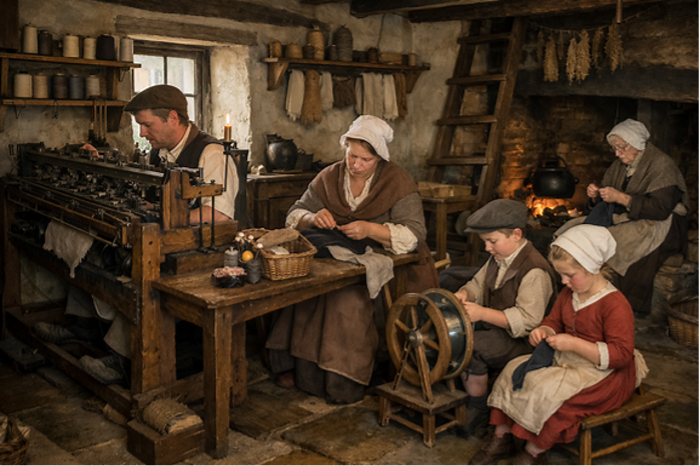
Framework knitters manually operated a stocking machine designed to knit wool into worsted stockings.
It was a cottage-based industry that involved the whole family. Father working the physically demanding machine, mother stitching the garments together, and the children winding the yarn on to the bobbins.
Even the elderly members of the family would have to play their part. There was no such thing as retirement.
This picture shows a framework knitter’s family working what could be a 10 to 12 hour day to make about 12 shillings a week. Out of that, they would have to pay rent of 1 shilling a week for the stocking frame.
By 1800, the Hinckley area had 1,800 such frames, and at its peak Newbold Verdon had 100 of these. Unfortunately, the mid-1800s saw the number of framework knitters reduced dramatically; overtaken by technology as faster steam-powered machines were built. The hosiery trade became centred on the local towns as large, mechanised factories were built.
There will be people reading this article who worked in those factories until their closure in the late 20th century as cheaper foreign imports made it impossible for the hosiery trade of south-west Leicestershire to compete.
Framework knitting is now part of Newbold’s forgotten past. There are precious few archived artefacts in our collection that directly tell the story of those who based their livelihoods on making worsted stockings. We are hoping the same does not happen to the hosiery trade of the 20th century, and we need your help.
If you worked in hosiery, or know of those who did, we would love to hear from you. We are looking to collect photographs and documents (we can make copies) and written or verbal recollections of those times that can be placed in the Archive.
Help us to ensure that that this once significant part of Newbold’s history is not lost.
If you want to know more:
Check out our short video below which is also on the Archive’s social media pages.
Hinckley District Museum is open every Friday and Saturday for most of the summer, and it is well worth a visit if you want to know more about framework knitting and the hosiery trade that followed. Details can be found at https://www.hinckleydistrictmuseum.org.uk/ For those with school-aged children, it offers an inexpensive morning or afternoon out.
A museum dedicated purely to framework knitting is the Ruddington Framework Knitters Museum in Nottinghamshire – www.frameworkknittersmuseum.org.uk Here you can see the knitting machines operating in the original workshops.