Two Rail Lines Planned for Newbold Verdon
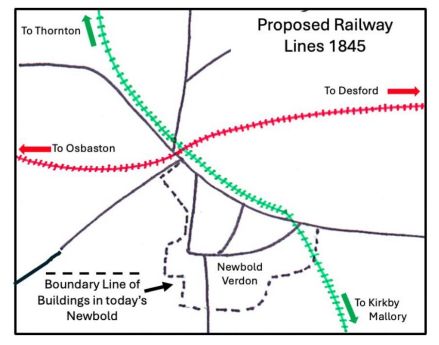
No, you are okay, we are not having two rail lines as well as all the houses, but it could have happened!
In November 1845, the Midland Railway Company submitted plans for exactly that. Detailed
documents of two proposed branch lines coming off the Leicester to Swannington Railway sit in the
archives at the Records Office in Wigston. The Midland Railway Company had purchased the L&S
Railway only three months earlier and wanted to connect the line to its existing rail network.
One of the lines would branch off from Desford, travel up the valley from Lindridge Lane and cross the
Barlestone Road just past the turning for Market Bosworth. It would carry on past Osbaston and
Market Bosworth before eventually joining up with the Trent Valley Railway at Polesworth.
The second was planned to branch off near to Thornton, running through the fields until it cut across
the Bagworth Road, through today’s Verdon Timber Yard, travelling parallel to the Barlestone Road
until it turned south just before the eastern junction with Main Street. From there, it cut through Red
Lion Lane, today’s Peter’s Avenue and onward to Kirkby Mallory, Peckleton and out to join the Midland
Railway at Leire.
Both lines were just over 13 miles long, and their plans include a parish by parish drawing of where
each line would run. Accompanying the drawings, each submission had a second document detailing
the owners of the land, their tenants and what the land was used for. It is a fantastic historical
document, providing the names of many of our villagers and where they lived and farmed.
The accompanying drawing to this article cannot do justice to those drawn up by Robert Stephenson,
the designer of the lines, but, hopefully, it will provide you with a little insight into what might have
happened had the plans gone through. We have yet to discover the reason why they didn’t and would
love to hear from anyone who does know: contact us at nvparchive@gmail.com if you do.
Alas, we do not carry the physical or digital documentation in the archives, but our catalogue provides information on where it can be accessed at the Records Office.