Newbold People No 4: Richard Gilliver (1921 to 1979)
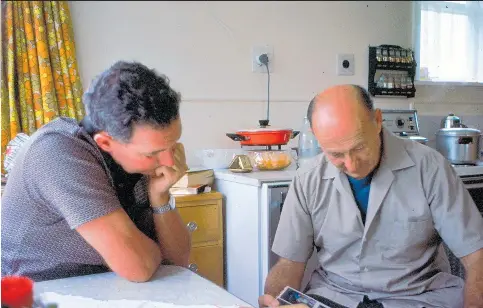
Here at the Archive, we have from time to time had some amazing stories land on our desk, and this has to be one of them. It came about when a somewhat battered newspaper clipping dating back to the late 1970s was brought in for archiving.
It told the story of an ex-Newbold resident who tragically died in an air disaster many thousands of miles from our village; his name was Richard Gilliver and the crash occurred in Antarctica in 1979.
Born in 1921, Richard grew up in Newbold Verdon, attending the village primary school before moving on to Broomleys Secondary School in Coalville. He lived with his family at Gilbert’s Farm, near the top of Brascote Lane. Little is known about his early years except that he worked on the farm; this led to him being qualified enough to take up the position of farm manager in Kenya, before moving to New Zealand in 1952 to work in forestry. In 1957 his mother sold Gilberts Farm, and the land was turned over to the housing developments we see today off Brascote Lane.
Those who knew Richard described a quiet, reserved man with a streak of adventure — enough, certainly, to inspire travels across the Pacific with his friend William Lomax.
On 21 November 1979, Richard’s 58th birthday, he and William travelled to Auckland Airport to board Air New Zealand Flight TE901, a one-day sightseeing flight to Antarctica in a DC10 aircraft. These excursions were hugely popular, offering passengers the rare chance to fly low over the Ross Ice Shelf, McMurdo Sound and, finally, the towering 12,500-foot extinct volcano Mount Erebus.
Air New Zealand had operated these flights for more than two years, and crews received special
training and detailed maps to ensure safe navigation. But on the morning of Richard’s flight, a critical
error occurred. The airline updated the aircraft’s navigation computer to correct a long-standing
coordinate mistake — but failed to inform the pilots. Believing they were flying the original safe route,
the crew unknowingly followed a new course that pointed the aircraft directly toward Mount Erebus.
As the aircraft neared McMurdo Sound, the weather became cloudy, and the crew descended through
a gap in the clouds. They then, unwittingly, turned the aircraft toward high ground hidden by cloud,
thinking they were still over flat terrain. When the pilots sensed something was wrong and attempted
to climb, the warning alarms sounded — but too late. Seconds later, the aircraft struck the lower
slopes of Mount Erebus, killing all 257 passengers and crew.
What should have been a spectacular, once-in-a-lifetime experience became the worst civil disaster
in New Zealand’s history, a tragedy still deeply felt today.
Recovering the victims was a monumental task. The crash site’s isolation, extreme weather and treacherous ice made the operation dangerous and exhausting. Ultimately, 214 victims were identified, and memorial services were held in New Zealand and abroad, including in the United Kingdom.
Yet it would take another 40 years before a National Erebus Memorial was finally established in Auckland.
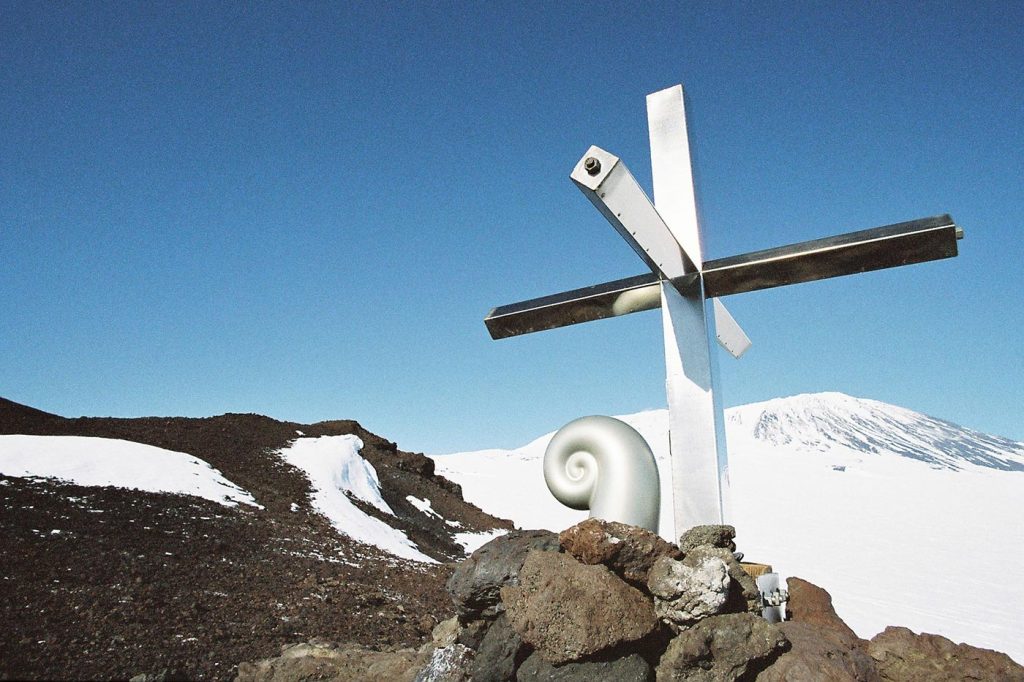
On the slopes of Mount Erebus, a memorial cross stands bearing the names of all who died — including that of Richard Gilliver of Newbold Verdon.