Gorby Knobbers get that Sinking Feeling
If you ever travel up the Bagworth Road you will pass through Gorby Knob.
This was once the nickname given to Newbold Heath by the villagers of Newbold
Verdon. No one seems to know where the name came from, but it stuck for a while, and if you lived at the Heath you were known as a “Gorby Knobber.”
Today, there are about 50 homes surrounded by farm land, something many residents cherish. However,
things could have looked very different if the Newbold Heath Coal Company had succeeded.
In May 1838, an advertisement appeared in the local paper, offering readers the opportunity to become a
shareholder in this newly formed company. The advertisement described how coal was known to be
close to the surface, making it cheap to mine and therefore very profitable. The proposed company did
not appear to establish itself, and it would be another thirty years before a further attempt was made.
Two established mining companies, Ibstock and Desford, attempted to outbid each other to purchase
Halifax Farm on the Heath, and with it the mineral rights. Neither succeeded after it was found that the
coal seams they had discovered would not be profitable enough to mine.
At that time the Heath was all farmland with six working farms. It was not until the beginning of the 20th
century that houses began to be built, in part to accommodate families of miners working at the nearby
pits of Nailstone, Bagworth and Desford. Ironically, it would be one of these pits, Merrylees, (a drift mine
extension of Desford) that would pose a threat to those living on the Heath.
That Sinking Feeling
By the early 1970’s, a small but vibrant community had formed at the Heath. It included a shop, the Heath
Garage and Wilkinson’s Haulage company. Several farms were thriving and just down the road the
woodyard was well established. On the surface things were going well, not so a few hundred feet below.
Underground, the Merrylees drift mine was extracting the very coal the 19th century coal companies had
sought after. Its proximity to the surface led to some houses and businesses on the Heath being subject
to severe subsidence and the possibility of collapse.
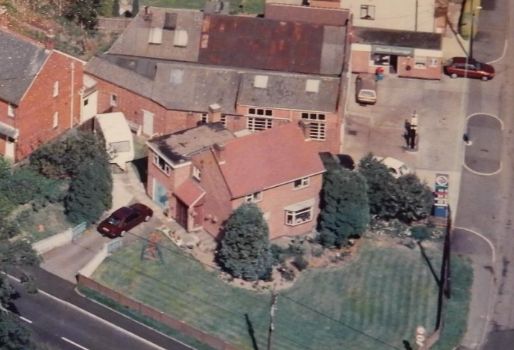
The accompanying picture is of the Bagworth and Merrylees Road junction. The house in the foreground
was one of those that succumbed to the subsidence. It was only saved by what was then an untested
process involving jacking the house up and placing strengthening pillars underneath. In the meantime,
the Wilkinson family that lived there were provided with temporary accommodation by British Coal.
Next month – July 2024:
What was it like to live on the Heath in the mid-twentieth century? Recollections from residents who lived and grew up in a very different Newbold Heath compared to today.