Newbold People No 2: Major Ronald Henry Statham MBE (1908 to 1969)
This series of articles celebrates those people who call, or have called, the parish of Newbold Verdon their home for some or part of their life, and who have a story worth telling and celebrating.
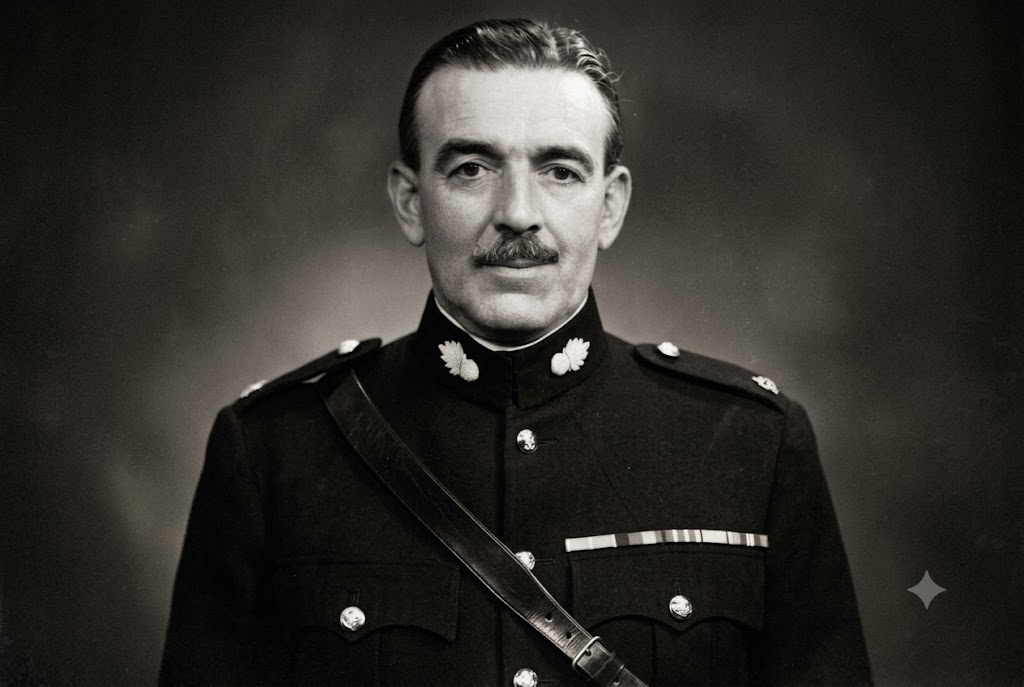
Our second article is about Major Ronald Henry Statham M.B.E. who was born and grew up in Newbold Verdon at number 39 Dragon Lane until he left to join the Army at the age of 21. His military career spanned 32 years during which time he rose through the ranks from Private to Major and survived 4 years as a prisoner of war working on the notorious Burma-Siam Railway. Ron was one of the long line of Newbold Verdon Stathams who can trace their village ancestry back to the early 1700s.
Family and Early Life
Ron was the eldest of five children born to George and Amy Statham. He attended Market Bosworth Grammar School where he achieved academic success and then worked as an insurance clerk.
Military Career
On 10th Jan 1930, aged 21, Ron enlisted as a private in the Royal Horse Artillery. In 1937 Ron, now a Bombardier, married Lilian Bustard and was a student at the Military College of Science in Woolwich.
Wartime Service
After attending the Officer Cadet Training Unit in Catterick, Yorkshire, Ron was promoted to the rank of
Lieutenant in 1940. By 1941 he was a member of the 1st Heavy Anti-Aircraft Artillery Regiment H.K.S.R.A., part of the Coast and Anti-Aircraft Defences of the British Malaya Command.
The Fall of Singapore
On the 15 February 1942, after the surrender of British troops to the Japanese in Singapore, a moment Churchill described as “the worst disaster and largest capitulation in British history”, Ron was held in Changi Camp as a Prisoner of War.
Burma-Siam Railway
The Burma-Siam Railway was 250 miles of railway constructed by Allied prisoners of war. Workers suffered long hours with back-breaking work, poor sanitation and malnutrition. It was said that one man died for every railway sleeper laid.
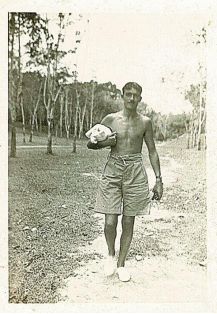
To diminish morale and reduce any organised action against them, the Japanese ordered PoW officers be separated from their men. Ron, along with other officers, was moved to Kanchanaburi PoW Camp in January 1945.
In August 1945, Ron was taken to his final camp – Nakhon Nayok, located approximately 80 km to the north-east of Bangkok. The announcement that the war was over was made to the men on August 17th and by September they began to be repatriated. It is reported that on his return to England he weighed 6 stones 7lb – half his normal body weight.
Service after the War
Once recovered Ron served with artillery units in England and in September 1951 was promoted to the rank of Captain and then to Major in December 1952. In 1956 Ron began work in the Quartermasters of the Royal Artillery at the War Office in London and lived with his wife, Lilian, in Bushey, Hertfordshire until she died in July 1958.
Ron often came back to the village to see his family. On short trips he would arrive wearing his uniform in a staff car.
New Years Honours 1961
Ron was presented with the M.B.E. by the Queen at Buckingham Palace for his long, valuable and faithful services to the Army.
Retirement from Military Service
After retirement from the Army Ron continued to serve in a civilian capacity and was based at the School of Artillery in Larkhill near Salisbury. He married his second wife, Doris May Hume, at the Garrison Church, Larkhill in January 1965. Ron and Doris lived in Amesbury, Salisbury until his death, aged 60, in 1969.